cellular
choreography
and
the development of ritual actions
ON ADVANCEMENT IN THIS PARATHEATRE MEDIUM
© 2000-08 Antero Alli
True initiation does not require ritual to occur; it is a spiritual event.
At best a ritual can act as a device or a tool to assist the expression
and integration of genuine initiation -- that which has never occurred
to one before and for which one can never truly be prepared.
The first initiation is Self-initiation -- the exposure of oneself to oneself.
This means to leave the self-conscious watcher behind and enter the
circle of participation. Words...images...explanations all belong to
the watcher. To the participant -- experience is everything.
SELF-INITIATION
Self-inititiation starts with immersion in the subjective experience, exposure and expression of the internal landscape. This initiatic stage is marked by identification and merging with sources of energy originating in the physical body, the personification of the subconscious. The results tend to be regressive, chaotic and dispersive; messy. Nothing of much apparent value is articulated or communicated outwardly beyond the utterances, sounds and motions of spontaneously convulsive expressions. However, this immersion stage can prove invaluable for authenticating and deepening access to the internal landscape and more vertical sources of energy streaming from above, within and below the body itself emanating up from the earth below. If we remain at this stage of the process, however, any further development ceases and our work stagnates in a quagmire of self-indulgent soup.
EXTRACTION
In the initial exploratory stages of Self-initiation, a certain identification with the energies becomes necessary. We become these sources to experience and know these sources firsthand. As we gain more confidence with accessing and expressing the internal landscape, we eventually realize the autonomous nature of the forces and archetypes that move through us. They are autonomous when they are not subject to our control or immediate comprehension; they are also autonomous when not a product of the ego. When we realize as much, we can see how we act as vessels for their expression. We discover that we do not own these forces nor are we creators of them as much as translators and transmitters of their presence through us.
This identity shift, or extraction, is implemented by relaxing identification with the forces themselves. This extraction allows enough self-detachment to play the forces, rather than being them or becoming them. The forces can then play through us as the instrument and the forces also play us. If we are not these energies that move through us, then who are we ? Good question. "Who am I ?". Keep it a question. This ongoing inquiry helps bypass the egoic tendency to fixate or finalize any self-image, a psychological inhibition that can only narrow greater access to the mystery we are attempting to experience, embody and express.
PATTERN RECOGNITION
Once this Self-initiation is set into motion, the organic stream of the body's impulses can flow more freely from subconscious depths into conscious physical expression and vocalization. At this juncture -- the threshold between unconscious and conscious -- we can detect the innate directions of the energy itself and their innate patterns of motion. These patterns are not mental constructs or conceptual overlays but autonomous impulses expressing their own organic rhythms, cycles and tensions through our bodies and voices when allowed to unfold on their own time and pour forth, as in a fountain.
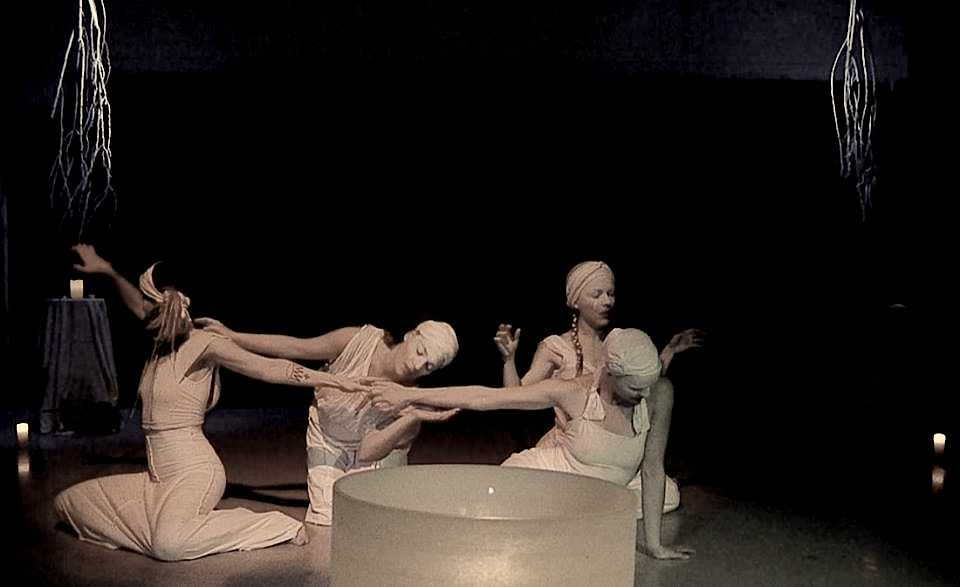
The Fountain ("vas hermeticum")
A SUSTAINING CARE
While tending to these patterns of motion, a sustaining care allows us to serve their expression through more precise gestures, specific actions and sensitive interactions. A sustaining care means showing an active respect for the spirit of the living impulses, rhythms and cycles while clarifying their expression into more precise forms. Too much precision kills the spirit, just as not enough precision results in a muddled soup effect. A certain kind of stamina is required for extending the duration of this fusion of precision and spontaneity. The stamina for maintaining such a dynamic balance requires a dynamic dexterity for surrender and control, for equal parts spontaneity and precision.
Cellular choreography and ritual actions
demand an ongoing tending to the dynamic
tension between precision and spontaneity
in their periodic fusions of concise expressions
of living impulses.
IN REVIEW
These processes convey three stages of paratheatre work, all of which overlap and inform each other; no graduations or final arrivals:
The first stage involves cultivatating enough internal receptivity -- via a deepening of the No-Form experience -- to energy sources in the body itself and then, to give these forces direct expression without imposing any preconceived outcome or "look". This first phase is devoted to Self-initiation, to accessing and expressing the internal landscape with minimal manipulation, and tends to be raw, chaotic, convulsive and "messy".
The second stage requires pattern recognition of the energies accessed and expressed. The aim is to distinguish and express -- in gesture, voice, action -- the innate patterns, shapes and "forms" emerging from these spontaneous eruptions. In the second stage we learn to serve the forms within the energy itself. Energy dictates form. The results are often half-formed, dramatic and/or expressive yet without necessarily communicating anything understandable.
The third stage requires a sustaining care for tempering spontaneity with increasing precision. Too much spontaneity turns the work into self-indulgent soup; too much imposed structure kills its life. A balance must be struck. This balance requires a certain stamina for maintaining the dynamic tension between precision and spontaneity, between form and force, or flow, towards ever-increasing durations. Stage three begins the Art of articulating what can also be understood by others. The results are often more economical, distilled, dynamic and specific.
To be cont.
-- Antero Alli
updated 12/12/2008
Links to Related Material (by Antero Alli)
principles, techniques & philosophy