questions and responses by Antero Alli
(updated 4/28/2023)
questions and responses
by Antero Alli
(updated 4/28/2023)
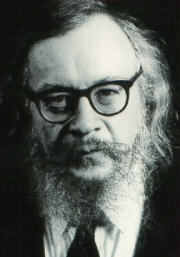
JERZY GROTOWSKI
Aug. 11, 1933 - Jan. 14, 1999
"We can see this phenomena in the categories of energy: heavy but
organic energies (linked to the forces of life, to instincts, to sensuality)
and other energies, more subtle. The question of verticality means to
pass from a so-called coarse level -- in a certain sense one could say
an “everyday level” -- to a level of energy more subtle or even
towards the higher connection". - Jerzy Grotowski
The term "paratheatre" was coined by the late Polish theatre director, Jerzy Grotowski, to address a highly dynamic and visceral performance style that aimed to erase traditional divisions between audience and performers. Paratheatre was also executed outdoors in the forests of Poland as non-performance events. After 1975, Grotowski withdrew from theatre entirely as a public performance medium to redirect his focus towards non-performance oriented group dynamics that developed through various stages: Paratheatre (1969-78), Theatre of Sources (1976-1982), Objective Drama (1983-86), and Art as Vehicle (1986-present). Grotowski's legacy and work process has recently reformed as "THEATRE NO THEATRE", Thomas Richards, director in Pontedera, Italy.
CLICK THIS FOR DETAILS ON THE STAGES OF GROTOWSKI'S WORK
Paratheatre, Theatre of Sources, Objective Drama, and Art as Vehicle
Paratheatre Beyond Grotowski
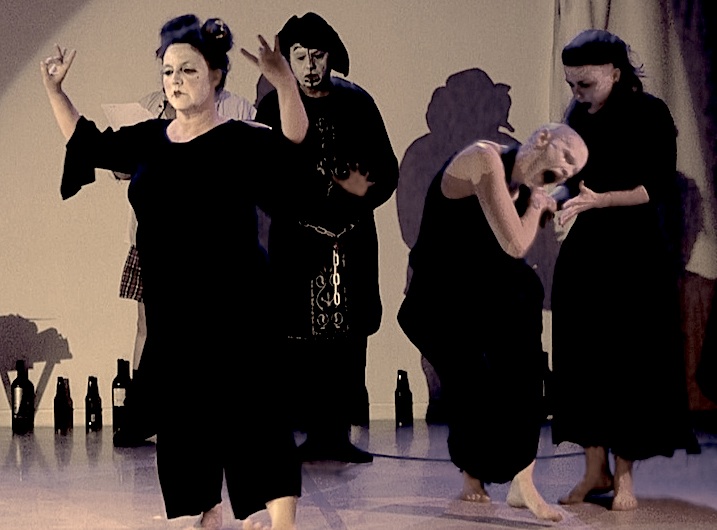
ParaTheatrical ReSearch; "Orphans of Delirium", San Francisco, May 2004
Are you doing paratheatre as defined by Grotowski?
No. ParaTheatrical ReSearch is Grotowski-inspired, not Grotowski-informed or defined. The term "paratheatre", like the term "theatre", undergoes periodic updating and redefining to serve the developing contexts of its practice and its practioners. Though inspired by Grotowski's early Paratheatre work (1969-78), this paratheatre medium neither follows or attempts to replicate his example. One important distinction separating this Paratheatre training from Grotowski's earlier work and most other paratheatre-related mediums is a standing meditation we implement, "no-form", as a central orientation in this work.
The purpose of no-form: 1) to deepen internal receptivity to the internal landscape of autonomous forces in the body towards their engagement and expression and 2) to discharge identification with these very forces after each engagement. The physical body, with all its hidden organs and complex interactive bio-systems, is posited as the embodiment of the Subconscious mind. Paratheatre methods are applied in an excavation process for making the unconscious, conscious in a visceral embodiment mirroring Carl Jung's method of "active imagination".
The term "No-Form" is borrowed from Buddhist Zazen practice. However, we do not approach No-Form as any spiritual path to samadhi or "enlightenment". Our No-Form practice is reframed as a tool for cultivating deep internal receptivity to the Body's innate sources of impulse, emotion, and responsiveness as somatic movement resources. We also do not practice No-Form as a sitting meditation but in a physical stance of vertical rest enabling a more direct expression through movement, dance, and physical actions. We also utilize the No-Form state to disidentify with and release attachment to whatever forces we're engaged to minimize the ego-inflation resulting from the influx of Subconscious contents into the conscious mind.
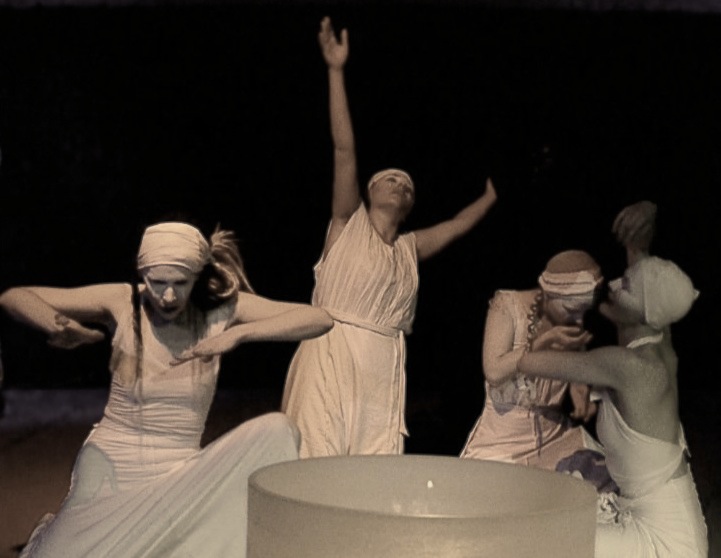
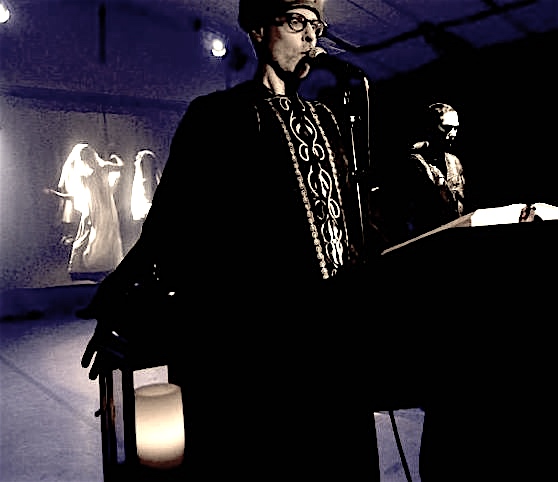
ParaTheatrical ReSearch; "Soror Mystica" Portland OR, December 2017
Is paratheatre the same as improvisation?
How do participants interact with each other?
Paratheatre is not the same as improvisation as commonly defined and used in theatre and dance. Unlike improvisation, group interaction in this medium does not depend on any external cues or wanting anything from others or the audience to spark, sustain, or motivate movement and interaction. This approach to group interaction follows an asocial directive. "Asocial" is neither antisocial nor social but a third way of relating. Neither socially hostile nor socially-conforming, an asocial approach starts with realizing our non-responsibility to others in the workspace. This adjustment can frustrate unmet social needs as it supports a different purpose for being in a group beyond meeting personal needs for approval, support, affection, courtship, acceptance, etc. An asocial approach redirects attention inward to the Body's innate sources - of impulse, emotion, sensation, power, etc. - and their expression through movement, sound, gesture, and action. Group work in an asocial climate supports greater authenticity, creative response, and integrity of self-expression. When we are more free of social considerations, we are more free to express ourselves more truthfully. We call this approach to group interaction, asocial interplay.
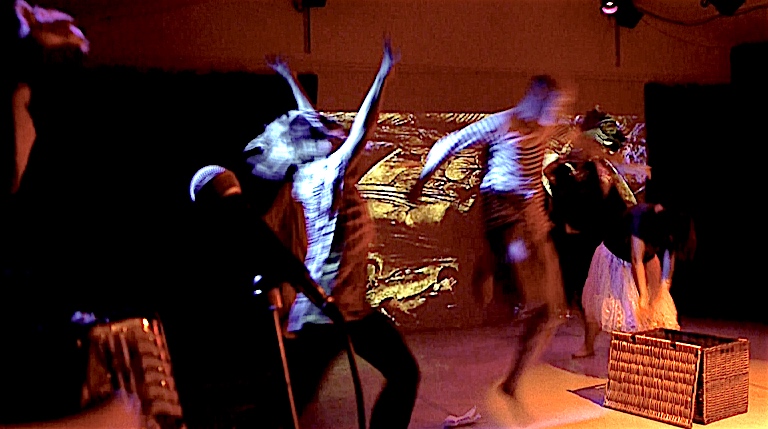
ParaTheatrical ReSearch; "Fallen Monsters" (Portland OR, May 2018)
What defines this Paratheatre training process?
Defining this Paratheatre training process can be difficult due to its many interactive methods and principles. There's the external, physical level of confronting "movement cliches" to expand movement vocabulary. The inner work of No-Form deepens internal receptivity to the Body's impulses, tensions, and emotions. The attention is also trained to align with the Body in present time while bypassing the thinking machine. This starts with paying attention exactly to what you are doing, moment to moment. This asocial approach supports novel modes of interaction uncommon to everyday social discourse. Overall, this training process follows a holisitic approach to sensitizing the instrument of the self towards more authentic, or organic, self-expression and interaction.
Paratheatre training has mostly occured indoors in a non-verbal, non-performance setting. Without an audience to impress or to entertain or please, the external pressures to perform are relaxed and replaced by the self-created pressures of increasing self-commitment to the given state, experience, and actions at hand. By training in a nonverbal climate, participants discover new ways to express and communicate internal processes through symbolic gesture, characterization, and relatable patterns of motion.
Before this work can begin, participants are asked to take a silent vow to themselves for becoming fully accountable for their own safety, well being, and their creative states. By agreeing to make ourselves safe in the face of upset or overwhelm, the often unconscious parent/child dynamics can be defused. As we decline to be made safe by someone playing "mom or dad" to us, we earn the skill of making ourselves feel safe enough to take risks, commit more to the moment, and the internal sources animating our expression. An asocial climate supports the activation and sustaining care of more creative states.
Click this for video demonstrating our Physical Warm-up process
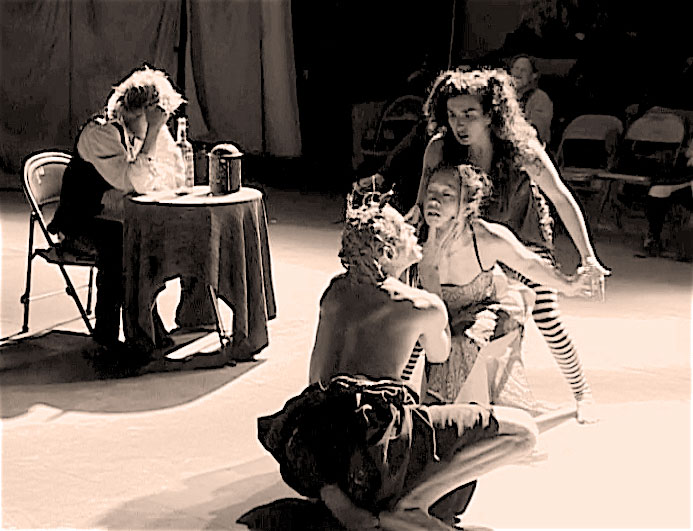
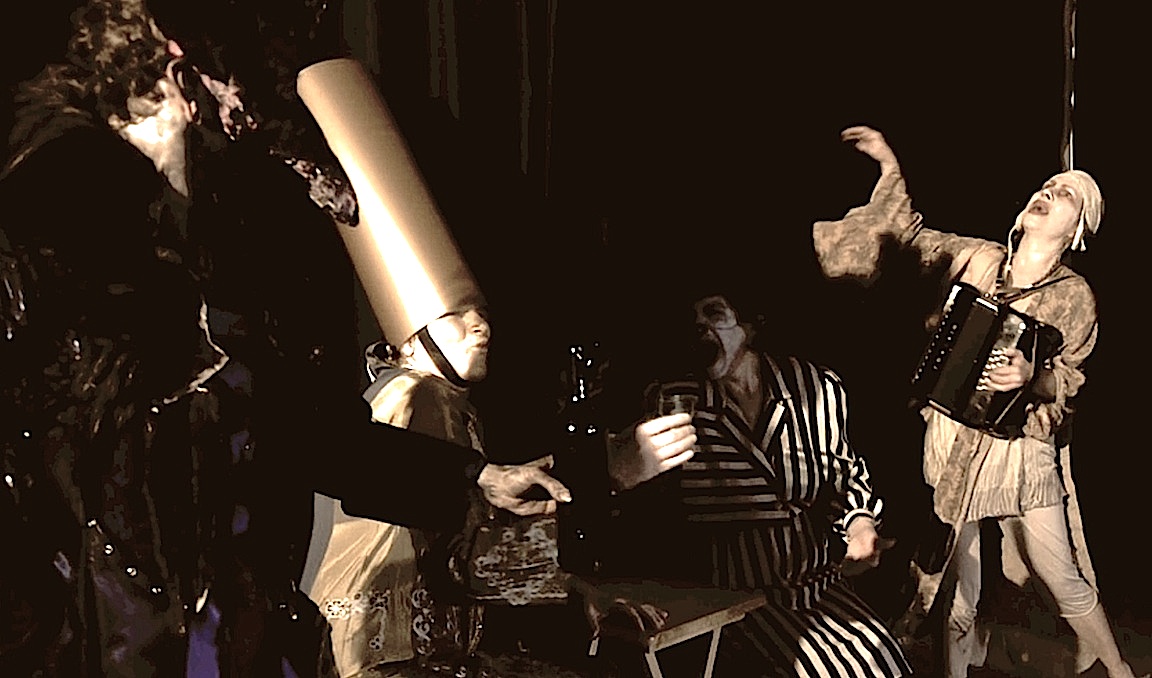
ParaTheatrical ReSearch; "Bardoville" (Portland OR, May 2017)
How does ParaTheatrical ReSearch present itself to the public?
ParaTheatrical ReSearch has presented itself in four public formats: 1) Talks (to discuss and explain the basic principles and methods of this medium) 2) Lecture-Demo (demonstration of work processes accompanied by explanation) 3) Performance (specific ritual infrastructures accompanied by poetic text, film, song and live music; no explanations) and 4) Video documents (representations of performance and non-performance modes). Between 2000 and 2015, ParaTheatrical ReSearch primarily served as a non-performance oriented process that focused almost exclusively on training, without audiences or witnesses beyond the facilitator. This 15-year era of mostly private, uninterrupted group work achieved its various asocial, kinetic, spiritual, and creative objectives of establshing a cohesive medium with its own principles and methods -- building a solid foundation for the next phase of this work: ritual into theatre.
ParaTheatrical ReSearch; "A Turbulence of Muses" (Portland OR, Dec. 2016)
Where does ParaTheatrical ReSearch go from here?
In early October of 2015, after nineteen prolific years of paratheatre labs, music and film production in Berkeley California, we (Antero and Sylvi Alli) relocated to Portland Oregon to explore paratheatre processes as a basis for creating a series of five public intermedia performance rituals. Our first production, "A Turbulence of Muses" (text by Arthur Rimbaud), a Symbolist Ritual premiered December 2-4, 2016. Our next production, "Bardoville" (text by C. Bukowski; vocal creations by E.V.E., Sylvi, musical director), an Intermedia Performance Ritual, premiered May 12-14, 2017 (to critical acclaim from Oregon ArtsWatch). Our following production, "Soror Mystica" premiered December 1-3, 2017 (also to critical acclaim from Oregon ArtsWatch). Our next paratheatre production, "Fallen Monsters" (text by William Blake) premiered May 11-13, 2018. Our most recent and final work, "Escape from Chapel Perilous" premiered Nov 29-Dec 2, 2018. All productions were staged at PerformanceWorks Northwest, PDX. In the fall of 2019, after 42 years of ParaTheatrical ReSearch, I decided to cease presenting all group work to the public. In 2020, I wrote State of Emergence: Experiments in Group Ritual Dynamics (Original Falcon Press), a book distilling the principle methods and philosophy of this work. In 2023, I wrote SACRED RITES: Journal Entries of a Gnostic Heretic (Original Falcon Press), a compilation of Lab reports and ritual journals documenting Paratheatre experience from 1999 to 2011.
ParaTheatrical ReSearch; "Escape from Chapel Perilous" (Portland, Dec. '18)
How is craft defined and developed in this paratheatre medium?
The development of craft in this paratheatre medium occurs over time with consistent application in 3 areas of work: identification, service, and sustaining care. All three areas are intimately linked with no final graduations or arrivals; all three overlap and contain components of each other.
IDENTIFICATION
The first stage starts with cultivating enough internal receptivity -- via No-Form practice -- to detect, engage and merge with energy sources in the body itself. Identification starts with a conscious choice to surrender to whatever source we are accessing in full-bodied immersive experience. The results can be chaotic, convulsive, ecstatic, and melodramatic without communicating anything beyond the catharsis of self-expression.
SERVICE
The second stage involves a shift away from merging, with whatever source we have identified with, towards serving its innate directives. This shift clarifies the forces in their innate patterns of motion, distinct characteristics, and rhythms -- resulting in more economy of movement and expression of whatever internal sources are engaged and identified with.
SUSTAINING CARE
The third stage involves an emotional investment in whatever source we are serving. This can occur by discovering what we care most about the source we are engaging and allowing this emotion of care to sustain our movement and expression. Sustaining care happens after engaging whatever source we are accessing, rather than from any preconception of what we might care about. Sustaining care arouses empathy for whatever internal source we are engaging and serving.
Click this for more on Advancing the Craft of Paratheatre
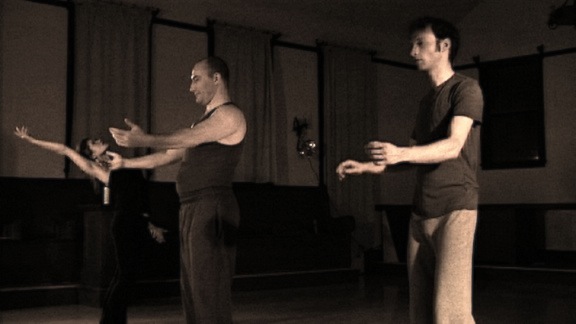
ParaTheatrical ReSearch; "dreambody/earthbody"
(video document; Berkeley CA, 2012)
What groups or individuals are currently active in paratheatre?
Currently, there are numerous offshoots and hybrids of Grotowski-informed work (those who have worked personally with Grotowski and Thomas Richards) and Grotowski-inspired work by groups and individuals all over the world. Listed below are some groups and their directors of paratheatre and paratheatre-related projects in the U.S.A.:
Thomas Richards; director, Theatre No Theatre (Pontedera, Italy)
Matt Mitler; director, Theatre Dzieci (NYC)
Stacy Klein, director, Double Edge Theatre (Amherst MA)
Joseph Lavy, Jennifer Lavy; co-directors, Akropolis Performance Lab (Seattle WA)
James Slowiak, Jairo Cuesta; co-directors, New World Performance Laboratory (Akron OH)
Additional groups in related fields, in and outside the U.S.A. listed at:
ParaTheatrical ReSearch Links
What books on paratheatre do you recommend?
c
c
click above images for product information and book excerpts
Towards a Poor Theatre by Jerzy Grotowski; click this for excerpt
At Work with Grotowski on Physical Actions by Thomas Richards
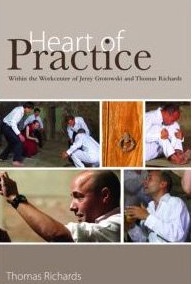
Heart of Practice by Thomas Richards
An Acrobat of the Heart by Stephen Wangh
Towards an Archeology of the Soul by Antero Alli; click this for excerpt
State of Emergence by Antero Alli; click this for excerpt
Full-length Video Documents, Interviews & Press Reviews
(1991-2023)
Paratheatre-related articles
by Antero and others
"Undoing the World"
a paratheatre manifesto by Antero Alli
CONTACT POINT
verticalsource@gmail.com