On Culture
From a non-sentimental view, I view culture as the result of any ongoing interactions between human DNA and geography, between tribes of people and the womb environment they settle in. When a given tribe dwells and builds community within any given bioregion, a distinct culture develops through their daily interaction with local food resources, power fields, the land and weather patterns sustaining them there. Any given culture is sustained and vitalized by the innate powers of its planetary bio-region and those rituals and customs that feed and protect the land. When the vital properties of any bioregion are violated and destroyed, the culture developing there can corrupt and eventually die.
Mountain ranges, deserts, shorelines, valleys, forests -- -- all carry distinct geomantic powers of influence shaping the daily lives and souls of the people living there, what they eat, the artifacts they create, and the technology (tools) needed to survive within the complex Planet/People weave known as "culture". When we take pride in "our" culture or believe we can "own" or "create" culture, a delusional field is ignited obscuring the true source and nature of culture. Nobody owns culture; we are more likely owned by whatever culture we live in. Nobody creates culture. We are more likely 'created' by culture. At best we can contribute to and maybe even advance a culture; at worst, we corrupt and destroy it. Any culture corrupts when it becomes excessively anthropocentric and loses touch with its revitalizing sources within the geocentric pulse of the living earth.
We live in an era of dying cultures. To survive, any culture or subculture must periodically return to those rituals and traditions that sustain it or new ones must be created. Any human culture achieves longevity by the success of its sustaining rituals, how well we are feeding the planet and how well we are being fed by it. Sustaining rituals return us to the primordial interaction with our immediate womb environment, through soulful communion and communication with the planetary entity. These sustaining rituals cannot always be understood or proven by any empirical methods. However, our primordial contact with planetary forces can be experienced firsthand through intuitive resonance with the Earth as a living entity that has incarnated as our planet. The Earth is not only more alive than we think; it is more alive than we can think. The planet is not dying; the egocentric cultures feeding off the planet are dying.
Some geomantic power fields and planetary hot spots carry innately charged conflict zones where highly volatile energies dwell and erupt without warning: earthquakes, tsunamis, volcanos, hurricanes, tornados, lightning strikes, landslides. The underlying causes of human conflict, violence and warfare may run deeper than bloodlust for revenge, money, power, oil, and religion. In these planetary conflict zones, we may be unconsciously acting as conduits, vessels, for the eruptions of warring geomantic forces innate to any region where conflict persists, century after century. Other networks of geomantic leylines and electromagnetic fields carry a deeper harmony supporting the development of more harmonious cultures and the people that inhabit these regions. The Earth calls the shots, has always called the shots.
We act on culture and are acted on by culture. Over time -- decades, centuries, aeons -- this genes/geography interplay crystallizes into symbols, languages, and artifacts that mirror, encode, encrypt and transmit the characteristics of each distinct cultural identity. Cultures developing in the Himalayan mountains will differ from cultures stimulated along the shorelines of southern India or the Sonoran deserts of northern Mexico or the lush Amazon river basin or the Cascadian forests of the Pacific Northwest. Each unique bioregion informs the nature of its tribe's religions, arts, mythologies, commerce, education, language, community rituals, and values. Though each culture maintains its own distinct signature by its unique sustaining rituals and traditions, all cultures are linked by the universal molecular language of DNA; we are all human beings living and dying on the same planet.
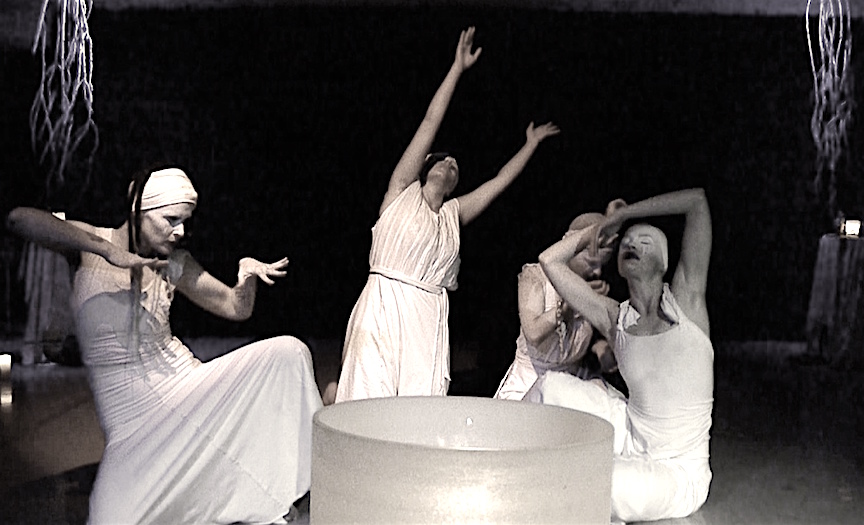
"Soror Mystica" - Dec. 2017 Portland OR
On Ritual, Theatre, and Paratheatre
Theatre acts as one of many sustaining rituals for keeping a culture alive. As with any sustaining ritual, the theatre must evolve
and
change over time to meet
the growing needs and values of the times, the people and their environment. Like a
snake
shedding old skin, any culture molts and grows by outgrowing
itself.
Any
theatre
that cannot outgrow itself ceases to function
as a
vital
sustaining ritual.
For theatre to remain vital,
a kind of “paratheatre” can be implemented to dismantle stagnant habits frustrating creative response. This kkind of paratheatre -- in the theatre but not of it -- can provide a time and space set apart to explore non-performance oriented experiments for accessing and excavating the internal landscape of autonmous forces in the Body towards their expression in spontaneous movement, gesture, vocalization, action and interaction.
This excavation process starts with releasing the pressure to perform and replacing it with the self-created pressure to increase one's commitment to sources of energy, impulses, power and grace within the Body itself. This redirection of commitment, from externals to internals, opens the door to verticality -- what can be experienced as energy/information flowing down from above and up from below, as a column running up and down the spine. Alignment with our innate verticality marks the initiatic stages of restoring receptivity and deepening our capacity for engaging and expressing the Body's primordial sources; the Body as a vital conduit of the Planet.
On Verticality
Traditionally, commitment to verticality has been achieved by various methods of
sense-deprivation (withdrawal of identification from external stimuli). Monastic
orders,
Tantric and Vedic yogas, and various spiritual disciplines find verticality
as a source of redemption, and/or enlightenment. Numerous systems of psychotherapy explore similar processes of interaction
between conscious Ego and the Unconscious, such as Carl Jung's Active Imagination, Dada Bhagwan's Self-realization, Dr. Abraham Mazlow's Self-Actualization, G.I. Gurdjieff's Self-Work and so forth.
However, rarely
have any of these spiritual methods been used to regenerate the sustaining ritual of theatre. One strident exception can be found in the work of the
late visionary of theatre, Jerzy Grotowski (Aug. 11, 1933 - Jan. 14, 1999) who coined the term 'paratheatre'
to address non-performance oriented group ritual work between 1969 and 1977 in the forests of Poland. However, Grotowski never claimed any actual 'legacy of paratheatre' due to the ongoing transmutations his group work underwent over three decades.
"With verticality the point is not to renounce part of our nature;
all should retain its natural place: the body, the heart, the head,
something that is "under our feet" and something that is "over the
head." All like a vertical line, and this verticality should be held taut
between organicity and the awareness. Awareness means the
consciousness which is not linked to language (the machine
for thinking), but to Presence." -- Jerzy Grotowski
NOTE: The term "paratheatre" will be used hereafter to refer to
the processes and resultys of my forty years of active paratheatrical research (since 1977).
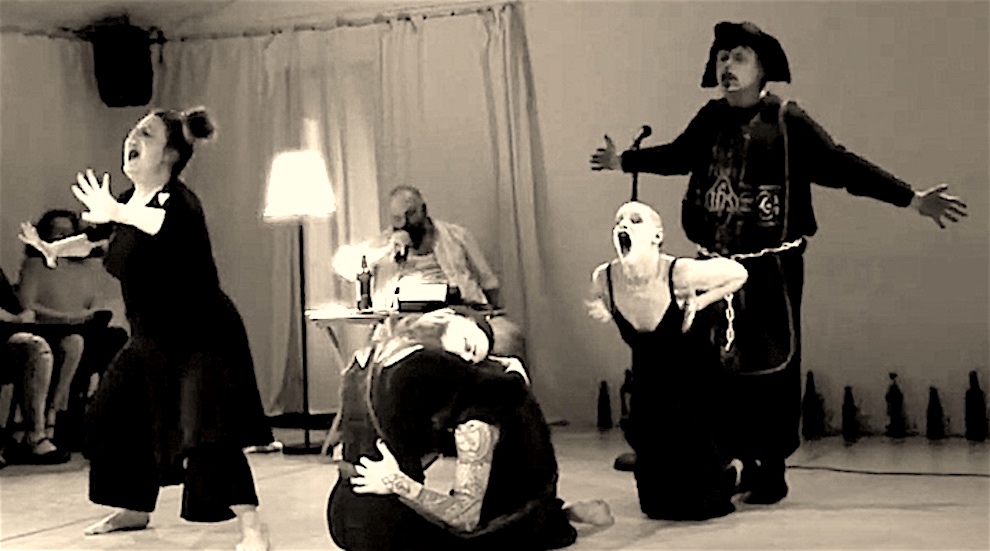
"Bardoville" - May. 2017 Portland OR
On Asocial Intent and the Archetype of Self
Groups create bonds of shared acceptance, support, and belonging through community-building social events. However
when these social bonds inhibit or frustrate
the expression of our true feelings and spontaneous responses, they can also impede and frustrate creativity. When a given group becomes preoccupied with maintaining
their social personas and meeting their social needs -- for friendship, courtship,
belonging, approval, security, status, etc -- this group begins feeding horizontally-oriented social needs where the sense of verticality is quickly lost and/or never established in the first place.
The experience of verticality can be accessed in an asocial work climate. Realizing an asocial intent starts with establishing our non-responsibility to others. Paratheatre training processes initiate a shift away from depending on external sources of energy (other people) and external stimuli (music, costumes, props, masks, etc) towards a more consistent internal dependence, ie., drawing energy, acceptance, support from verticality. This asocial direction is neither antisocial or social but a third point of orientation necessary for increasing personal commitment to verticality and one's current state of being -- free of social considerations about what others might think, feel, believe, react or say about it.
This shift from external to internal dependence replaces social considerations with an active expression of our most honest, spontaneous, and authentic responses. Without this adjustment, the "default" conditioning of our local culture's socialization 'programs' easily dominate the tone of group interaction and corrupt the quality of paratheatre work with social cliches, play-acting, and conditioned reactions. Actualizing an asocial intent naturally frustrates social compulsions and needs, such as seeking external acceptance, support, approval, status, courting and flirting, community belonging, and other needs to bind social agreements. Social needs are obviously important and why they are best met outside of the paratheatre workspace. By relaxing our social agendas and motivations, we can begin sourcing the internal landscape of autonomous forces in a somatic expression of what Carl Jung calls Active Imagination for making the Unconscious, conscious. This process opens the door to Self-initiation through the archetype of The Self.
"The Self is a quantity that is supra ordinate to the conscious ego. It embraces not only the conscious but also the unconscious psyche, and is therefore, so to speak, a personality which we also are. The Self is not only the centre but also the whole circumference which embraces both conscious and unconscious; it is the centre of this totality, just as the ego is the center of consciousness." -- Carl Jung, Two Essays on Analytical Psychology