
Part Five: Self-initiation
the bridge between worlds; amor fati;
what drains the power of dreaming
© 2005 Antero Alli (updated 3/15/23)
ON THE BRIDGE BETWEEN WORLDS
Perhaps the most challenging aspect of paratheatre work rests with its integration into daily life experiences. Insights, realizations, and epiphanies erupting in paratheatrical processes can disappear if they cannot find expression and integration beyond the workspace. Without the application of "Lab" insights into daily life, these rarified moments can quickly dissipate like fading photographs. For this paratheatre work to have any lasting influence and value, we must find ways to build and maintain a kind of bridge between worlds -- between the internal landscape of the soul and the external world of daily life -- between the infinite and finite dimensions of existence. How to arouse ecstatic moments amidst our day to day toil and drudgery? Where to find No-Form when snagged into someone else's soap opera melodramatics? When and how to engage verticality amidst the insanity of a corrupt society? Questions worth addressing.
We humans have always, will always, seek out and invent new ways to alleviate boredom and to get high and/or attempt escape from the banal tedium of mundane existence. How to escape? Many escape attempts lead to dispersion and self-destruction, where no true escape happens at all. If this need for escape really is innate to being human, how can we actually escape? Escapism itself is not the problem. The problem is this naive assumption that we can escape from reality. Nobody escapes reality.
To truly escape, we have only to shift the context of escape -- from trying to escape from reality towards escaping into reality. Escape here means to accept the existing conditions of our lives and commit to passing through the very heart of whatever experience that is. By choosing to escape into the existing conditions of our lives, rather than away from them, we are courting amor fati - the love of our fate. I look at fate as whatever happens; nobdy controls fate. Amor fati means no matter what happens, it's all good or OK or at the very least, necessary. We may not like our fate at any given turn but it is futile to fight fate; resist existence and expect resistance. By acceptance and commitment to What Is, we open to the pulse of mystery beating at the very heart of existence itself. Amor fati does not refer to any passive acquiescence but an active deepening of access to self, the world, life itself and its expression in your daily life. However, it takes a particular kind of power to maintain this bridge between worlds. This kind of power does not originate in any Nietzschean personal will to power or by wishing or hoping it might happen. This power does not originate in our personal efforts. It already exists as an innate source within us that has become diminshed by specific habits of power loss that drain it out. I call this the dreaming power, not wish fulfillment but the innate power of animating existence which, in and of itself, may be a dream.
Building a bridge between worlds requires knowledge of where and how this power of dreaming is being drained. Many habits of power loss remain unconscious and/or stem from impersonal cultural origins. When we wake up to how we are losing power, we are faced with the choice to minimize and/or eliminate the drainage points in our lives or keep suffering from power loss. Self-imposed habits of power loss can be self-corrected. Other sources of power loss are imposed on us by others and by the impersonal dominator culture at large and may require different strategies. Once our power drains are exposed and released, the power of dreaming returns on its own volition. Nothing else has to be done. Remove the drains and the dreaming power returns of itself. This power is not of our personal will but of the cosmos itself. Restoring the dreaming power helps sustain the bridge between worlds and expresses an ongoing ritual of Self-initiation.
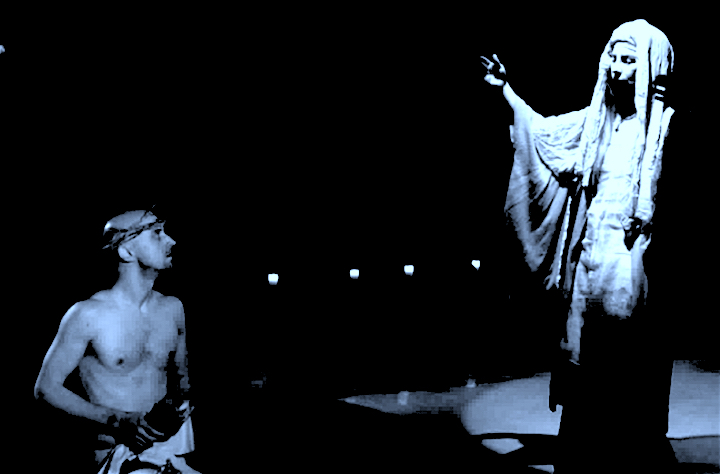
"Escape from Chapel Perilous" - Dec. 2018 Portland OR
HOW THE DREAMING POWER IS DRAINED
Perhaps the two greatest drains to the dreaming power are: 1) The Poor Baby Syndrome and 2) Courtship Compulsion. Both drainage points diminish the energetic body, the chief conduit for the power of dreaming.
The Poor Baby Syndrome corrodes the will. This power drain is maintained by self-pity and the immature refusal to accept one's personal shortcomings, inadequacies and flaws. It manifests ouitwardly self-denial, constant complaining and whining about feeling "not enough". Poor Baby! When afflicted by the Poor Baby Syndrome, we become as emotional vampyres feeding off the sympathy of others while hosting Pity Parties in private or comiserating with other Poor Babies. This self-victimizing habit acts out in a disempowering cycle that shrinks the decision-making muscle, resulting in a self-created anguish of indecision. The mass culture of advertising feeds and controls the Poor Baby syndrome by appealing to the unmet needs of the emotionally immature consumer, i.e., you are not enough without our product!
Self-denial feeds the Poor Baby. Defusing the Victim archetype starts by learning to trust your firsthand experience as a source of authority. This can happen as you become more accountable for your feelings, ideas, beliefs, choices, actions, and their consequences. As self-accountability increases, self-acceptance eventually replaces self-denial as a powerful foundation of self-support, allowing for greater personal freedom, integrity, and creativity. Easier said than done, however. Facing the internal ravages of this habit of power loss can be painful to bear and may require professional psychotherapy if the damage has become too overwhelming for the ego.
Taking everything too personally fattens the Victim. Those who are easily offended suffer from excessive self-importance and negative ego-inflation. This can happen in two ways: 1) negativity of low self-worth and/or 2) the positive inflation of exaggerated self-worth. Unless you're creating a Clown character for a theatrical performance (taking everything personally makes any clown funnier), it's a good idea to discover what is actually personal to you and what is not. Not everything is personal. In fact, most of life, society, corporations, governments, the culture at large and the world at large doesn't give a fuck about the person - these agencies are all impersonal by nature. Distinguish yourself or be extinguished. Knowing what not to take personally means not taking most things personally.
COURTSHIP COMPULSION AND POWER LOSS
Courtship Compulsion ravages the energetic body of the soul and its psychic home, the imagination. This complicated power drain occurs with any excessive emotional investment in an idealized image of the "dream lover", and/or any obsessive search for "The One", the "soulmate" or "twin flame". When these projections are imposed onto any external person, who somehow matches that psychic image of the "dream lover" (what Carl Jung calls "the Anima" in men and the "Animus" in women), we can become as psychic vampyres merging with the energy of another in a misguided attempt at achieving "oneness" or some new age kind of "alchemical tantric unity".
This power drain also taxes the imaginable faculties that might find more productive and creative outlets through Art, Poetry, Music, Dance, Theatre, Cinema, etc. Without creative outlets, all that psychic energy can naturally implode into a seduction of self-destruction. Courtship compulsion takes tremendous psychic energy to sustain itself and leaves us emotionally drained, always wanting, always needy. It's a dumb-downing spiral of diminishing returns. NOTE: It's not courtship itself that drains our power but the one-sided unrequited compulsion that occurs mostly in our own heads with very little to show for itself beyond the power loss it creates. .
Courtship Compulsion veils a sophisticated ritual of self-torment where love is always wanted but never truly found. The mass culture of advertising feeds and controls the Courtship Compulsion by the Beauty Myth oppressing every woman and man mistaking glamour for true beauty (see The Beauty Myth by Naomi Wolf). Glamour casualties are assimilated into a vapid world of appearances that drains the inner life of power and substance. A narrowing of consciousness soon feeds the negative spirits of Envy and Greed, the endless comparisons of oneself with others, resulting in a meaningless Hungry Ghost life.
Courtship Compulsion mythologizes unconditional love. When we seek and expect unconditional love from another person, it places them under pressure to deliver the impossible. What flawed human person can love unconditionally all the time? As this external projection of a need for unconditional love persists we can easily fall into the Poor Baby life where any kind of love we receive never measures up. Snagged in this web of self-deceit, we overlook how each of us may be love at essence. How radical an idea to be the love we seek from others? By realizing as much, we can enjoy romantic liaisons and endure long term loving relations -- not from any desperate need or search for love but -- from the offering of self as love. And where being in love - by inhabiting our essence as love itself -- takes on new meaning.
Part One: Orientation
culture, paratheatre, verticality, asocial intent
Part Two: Integrity Loss and Recovery
the force of commitment, what feeds the being
Part Three: The Performer/Audience Romance
talent and skill, the total act, the No-Form technique
Part Four: Self-Observation and Ego
function of ego, embracing contraries, the emotional plague