delusion
A delusion is commonly defined as a fixed false belief and is used in everyday language to describe a belief that is either false, fanciful or derived from deception. In psychiatry, the definition is necessarily more precise and implies that the belief is pathological (the result of an illness or illness process).
Delusions typically occur in the context of neurological or mental illness, although they are not tied to any particular disease and have been found to occur in the context of many pathological states (both physical and mental). However, they are of particular diagnostic importance in psychotic disorders and particularly in schizophrenia. -- wikipedia.org
It's been my experience so far that the potential for self-delusion comes with any work, solo or collective, that triggers the expression of autonomous forces from the Unconscious into the conscious ego. Throughout my forty years of leading, and participating in, group paratheatre processes, I have encountered certain forms of delusion within myself and in the attitudes, behaviors, beliefs, and actions of others. As a facilitator of paratheatre, I hold myself responsible for the various influences this work has on myself and on others.
To honestly address the issue of self-delusion, two important questions must be asked, over and over again: what is it that I am actually attempting in this paratheatre work and why am I doing it ? - Antero Alli
WHAT WE DO IN THIS WORK AND WHY WE DO IT
The overall aim of this work is a liberation of authentic response, interaction, and being. The initial stages of training in this work can evoke a series of exposures of the culturally-conditioned and randomly absorbed assumptions, fixed ideas, self-images, belief systems, dogmas, inherited or absorbed from our parents, teachers, books, media and the culture at large and, what we have mistakenly identified as "ourselves". The inherent challenge in this exposure process is with discernment -- between the external conditioning of socially-accepted, familial and politically correct responses, values, beliefs, and ideas ~ and ~ the spontaneous expressions of our true thoughts, impulses, feelings, perceptions, and actions.
This quest to rid ourselves of toxic cultural influences can sometimes incite an outright revolt and renunciation of all second-hand information in lieu of turning to our firsthand experience as our most direct source of spiritual authority. As noble an aim as this can be, this path can also be rife with self-delusion and why it may be critical to continue examining the nature of delusion itself, its possible causes, and whatever adjustments might help to defuse or minimize it.
To express authenticity of being, doing, and relating means to fully commit to restoring our capacity for a more direct experience. This capacity for experience can be obscured or corrupted by over-identification with other people's opinions and the socially-accepted, cultural ideals and roles we play. If we are able to restore our capacity for more direct experience, we can gradually (re)build a self-trust - by earning more respect for our own perceptions, true feelings, and instincts.
In this paratheatre medium we engage numerous ritual forms and designs to evoke the existing conditions of our lives, whatever their nature. By facing, accepting, and eventually embracing the existing conditions of our lives - not what we hoped for if this, that or the other were different -- no, I refer to the existng conditions of our lives. By earning more respect for existence itself, we can start to recognize the tendency to pretend, or imagine, or idealize ourselves. To actualize ourselves, we must first stop investing in an Ego Ideal, that is, any ego ideal. In this reality-based approach, the Actual can eventually become the Ideal by an ongoing conscious choice to surrender to What Is. Contrary to what we may assume, this self-actualization process stimulates the poetic imagination, not towards more fantasy and illusion, but towards the enthrallment of realizing our dreams and aspirations.
"Existence itself may be considered an abyss possessed of no meaning.
I do not read this as a pessimistic statement but a declaration of autonomy
for my imagination & will and their most beautiful act of bestowing
meaning upon existence itself." -- Hakim Bey
ON BECOMING AS "LEGENDS IN OUR OWN MINDS"
ParaTheatrical ReSearch Labs offer a rich palate of pathways and techniques for accessing the internal landscape in dynamic and sometimes cathartic ways. With practice, these processes can arouse deep feelings, insights, revelations, and epiphanies about oneself and one's place in the cosmos. However, any experience -- no matter how profound at the time --can easily vanish as fading memories if they are not applied and integrated into daily life.
Any deeply-charged subjective experiences - like those that occur in Paratheatre - lead to self-delusion if we assume the experience was enough to significantly change our lives. Without consistent follow-through and application of our realizations, we can easily become entranced by the spell of thinking we are doing something important when, in fact, we are only thinking ABOUT doing something important. What actually gets done is self-delusion. Without applying or integrating our insights into the larger fabric of life beyond the ritual setting, we set up a delusory escapist relationship with ourselves and the ritual work itself, a mental habit that can lead us to excessive ego-inflation as "legends in our own minds".
When we approach ritual work with the intention or hope of escaping the drudgery of mundane existence, we risk a kind of presbyterian milktoast approach to transformative work. Picture millions of people who work forty-plus hours a week, get drunk on the weekends and attend Sunday morning church to pardon their sins. This kind of escapist self-delusion can be curbed by testing and applying the results of one's ritual work in daily life. For example, we might practice no-form while waiting in line at the grocery store or let's say, source the Earth while jogging or walking or maybe show more respect for the personal space of those we are intimate with. Or, align with vertical sources while facing a difficult encounter with an adversary. There are countless ways to silently and unobtrusively apply paratheatre methods to everyday routines, affairs, and relations.
ON BUILDING A BRIDGE BETWEEN WORLDS
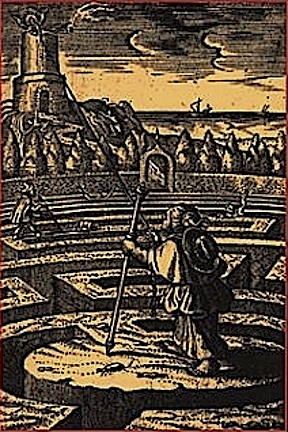
Our most cherished experiences and deepest impressions crreate memories that form the very sediment of our souls. To the degree these emotionally-charged images remain within the sphere of our innermost lives, with little expression in the outside world of others, a kind of alienation can result. As this sediment of memory grows richer with subconscious layers upon layers of past experience, we can easily succomb to the cumbersome inertia of excessive internalization. To alleviate these internal pressures we must find or create outlets for their expression and communication.
This involves a kind of bridge-building process between inner and outer worlds, an ongoing process of Self-initiation where we are making the Unconscious, conscious while bringing the light of consciousness to the subterranean depths of our being. In this initiation process, neither the inner life of the soul (the vertical domain) nor the outer events of others and the world (the horizontal domain) matters as much as maintaining the fibers of their connectivity. To maintain this bridge between worlds we must learn to entertain a kind of double vision, a perspective that can hold an awareness of vertical and horizontal realms together. Adapting this kind of double vision allows more freedom to come and go between worlds by continuing to traverse between them.
NEGATIVE EGO INFLATION: THE "POOR BABY" SYNDROME
Sometimes paratheatre work (and any truly transformative ritual work) can ignite an epistemological crisis -- where our current values are exposed as meaningless, trivial, obsolete and/or worthless. This crisis can sometimes result in an emotional downward spiral of despair and diminishing self-worth. When we cannot stop condemning ourselves for failing to live up to the bloated expectations of our ego ideals or skyhigh standards, we suffer negative ego-inflation. This can also happen after we are shocked by the exposure of any excessive narcissism and its encumbent loss of empathy; to bear the heartlessness of our selfish ways. Other times we may feel morally outraged at the greedy, godless existence of society at large. All this "bad news" can sink us into self-pity over our perceived wretched condition. We may blame our failure on the culture at large. No matter what the cause or the symptoms, when our spirit is crushed by self-imposed negative attitudes and beliefs, we can easily become victims of our own self-imposed suffering. Poor baby! Any excessive negative inflation results in various forms of a passive martyr complex or, the "Poor Baby" syndrome, that drains our power and ravages the energetic body.
Power loss and emotional drainage expresses two symptoms of the self-important negative inflation of the Poor Baby syndrome. Since paratheatre work demands a healthy ego and a supple energetic body, it may be impossible to do this ritual work in a state of negative inflation or low emotional energy. It is like trying to drive a car with an empty gas tank. Without an ample supply of emotional energy, paratheatre turns rote, contrived or superficially "play-acted". To break the cycle of negativity, the Victim archetype of the Poor Baby syndrome must first be exposed, defused, and dismantled.
Negative inflation can be a natural response to facing any situation perceived as an impossible task or endeavor. We feel discouraged and give up. Poor baby! It may be natural enough to feel ineffective, to feel helpless, and to feel inadequate in the face of any hurdle we perceive as insurmountable. However, feelings of helplessness and inadequacy are not the same as being helpless. Feelings of inadequacy are not the same as inadequacy of being. When negative emotions are mistakenly identified with, we become self-deluded into believing they are absolutes. Emotions are not absolute; they just feel absolute. When over-emphasized, negative emotions diminish the being; we become more negative as our authetic self shrinks. Negative being amounts to an absence of being - a non-entity.
Negative energy can also express resistance. Resistance expresses energy in its frozen state. If we can experience resistance directly as a source energy, it can be released and expressed. By sourcing resistance as an energy, we can stop resisting resistance and start blending witn it. Blending with the resistance, as Aikido and other martial arts teaches us, liberates previous trapped energy; ice melts, turns fluid. By continuing to resist the resistances of our lives, we feed the Poor Baby syndrome while draining our power with whining and complaining. Why make a bad thing worse by turning an already difficult situation into some kind of fresh hell ? Poor baby!The Poor Baby complex feeds an overly complicating web of self-created drama that mistakes pain for food. Sometimes the Poor Baby complex can bring positive results if our suffering sensitizes us to the suffering of others and deepens our empathy and compassion for ourselves.
POSITIVE EGO INFLATION: THE MESSIANIC COMPLEX
Conscious surrender to, and embodiment of, archetypal energies -- an important ritual talent -- can naturally result in positive inflation of ego, or self-image. We can become "as gods and goddesses" for the moment. Positive ego inflation expresses a natural phase of ego development. As we open up to more aspects of our Whole Self, we discover the inherent contraries of our true nature -- we are good enough to be bad, intelligent enough to confess ignorance, independent enough to embrace dependencies, strong enough to feel weak. Aaccepting and embracing internal contraries nurtures an ongoing alchemical transformation within us -- within the Vas Hermeticum of the Body itself.
Positive ego inflation starts when we confuse the ego for The Self and forget how ego expresses but one aspect of The Self. When we confuse the ego for The Self, self-delusion enflames a messy messianic complex inflating our sense of sel f-importance and entitlement. This confusion can result in attitudes, behavior, beliefs, and actions of excessive narcissism. We become more easily offended and/or lose a sense of humor about ourselves. We erroneously expect others to take us as seriously as we take ourselves. Sometimes these internal expectations are fed by squads of Yes Men and Yes Women who buy into our fantasy and help to maintain our self-delusion. When these delusions of entitlement lose the support of others, our egoic bubble bursts releasing hot air and noxious gasses - the gnashing of teeth! the bearing of claws!
ON RELIGIOUS CONVERSION EXPERIENCE
Another symptom of the messianic complex manifests as a compulsion to convert others to beliefs falsely assumed as absolute truths or realities. As this self-delusion escalates, the ego bloats by identifying itself as a kind of master, messiah, or savior figure stridently rallying others behind its bloated cause. These conversion tactics often express a naive reflex following any genuine religious conversion experience. When we experience God - in whatever form or shape - we naturally want to share God with others, whatever that God has been made into. We humans have been historically consistent in making a religion out of almost anything and rallying others around the alters and the churches, not to mention the scores of pedophile priests and sex addict gurus.
The messianically deluded can overstep the personal boundaries of others in their unconscious attempts to regain control over their own (out of control) lives. Sometimes this involves attempts to manipulate or coerce others into sharing the premises of their own delusions, ie., "my vision is THE vision for all of humanity." When these messianic assumptions are questioned or refuted by skeptical others, hostility and aggression can arise. Unspeakable violence and warfare have erupted over the last two thousand-plus years from pure messianic rage. Beware the slippery slopes of paranoia and violence hiding within religious symbols, nationalistic flags, and fundamentlist sects of any color or race.
SHADOW WORK: THE SCAPEGOAT COMPLEX
Paranoid delusions can sometimes require an external scapegoat or an outside "enemy image" to justify the "rightness' of fanatical visions, beliefs and dogmas. These "enemies" can be larger governing bodies -- actual governments or political leaders or entire socioeconomic castes, genders, races, etc -- that somehow mirror the Shadow of the person or group identified with a messianic complex. Scapegoats can also manifest as any individuals that oppose the self-deluded person's cherished dogmas. In other cases of self-denial, the ego itself is scapegoated in a kind of reversal of the persecution complex where others are painted as the egotistical, self-important deluded ones. When this type of reverse scapegoat complex backfires, the self-deluded person can ironically become the object or target of persecution him/herself. Kettle, meet pot.
If it has not gone too far, the messianic complex can be remedied by any carefully enforced isolation. To withdraw and separate oneself can sometimes serve to deflate the ego back to "body size". For example, the self-deluded person can participate in a ten-day Vipassana Meditation retreat or if they are resiliant enough, spend four or five days camping alone in the wilderness. Any form of sense-deprivation and self-imposed solitude can help alleviate the suffering of excessive positive ego-inflation.
When especially charismatic persons suffer from a messianic complex, their powers of persuasion can easily delude others ("my people") into buying into their fantasy. This is why enforced isolation can be an effective self-healing ritual. Another measure of freedom from this kind of self-delusion can be achieved by learning to listen and pay attention to others without immediately verbalizing self-referential commentaries ("oh, that's what I do" or "I feel just like that, too") or offering advice. By seeing others in their own context and hearing out their stories, we can restore the warmth often missing from self-delusion.
THE EGO SOLVENT OF NO-FORM
Effective strategies to defuse the positive inflation of the Messianic complex can be found in any ego-corrosive actions where we place ourselves in service to others. This can take any number of forms, from actions that alleviate the suffering of others to assisting those who cannot help themselves to performing hard physical labor for the benefit of another. Ego-corrosive actions, however, are not for everybody. Those with more fragile egos or who cannot endure or stomach the suffering of others, may not find it as useful.
In this paratheatre medium each and every engagement with archetypal forces begins and ends in no-form, a standing Zazen meditation technique for disidentifying with any preconception, image, force, idea or belief, towards cultivating deep internal receptivity. No-Form represents a kind of intimacy with the fertile Void, our potential state of being nothing. From the receptive state of no-form, we can begin detecting energy sources, currents, and forces in the body itself. These energy sources are then engaged as movement resources for animating motions, gestures, sounds, and actions. As our commitment
to the body's energies increases, these somatic currents can lead us into the deeper collective wellsprings of archetypal energies.
The deeper the immersion and identification with any archetypal force, the more powerful and emotionally charged the experience. As we gain deeper access to the internal landscape of the archetypes, a deepening no-form practice is required lest we risk self-delusion by walking away after the ritual believing we are as gods or goddesses, or demons and angels, when we have only inflated our egos. This is why after each ritual in this paratheatre medium, we diligently return to the no-form stance to discharge and disidentify with whatever source of energy we have immersed in and merged with. By deepening our commitment to No-Form practice, we can approach this work with the humility and respect it deserves and demands from us.
ON BREAKING CERTITUDE TRANCE
Self-delusion can also result from suffering the illusion of excessive certainty. We delude ourselves this way after fixating on any picture, image, idea, vision, belief or assumption as an absolute in our minds. The self-deluded mind confuses opinions for facts, and fantasy for reality. This tendency of mental fixation can be defused by learning to relax the search for meaning and by allowing things to happen without trying to control the outcome. This can yield a more direct experience of any phenomena if we can relax projecting or assigning meaning to it; relax interpretation and open to more experience. This process begins the training of the second attention, that awareness not linked to the thinking machine or language but to presence, energy, and phenomena.
To break the trance of excessive certitude, permit more uncertainty. This can be accomplished in many ways. Make an effort to read books and magazines that hold no previous personal interest or gain for you. See if you can find points of interest beyond your previous and current beliefs. Attend social gatherings where you don't know anybody and where the purpose of the activity holds no previous fascination for you. Avoid mirrors; they can only offer reflections, never realities.
Experiment -- spend a week without looking into any mirrors and see what happens. See if you can live a day without a self-image, or without fixating on any idea of who you are or should be. Breathe in the rare air of a concept-free zone. All these ego-corrosive actions involve getting your attention off yourself. Other ways of getting your attention off yourself might include serving the well-being of others and/or the alleviation of their suffering. Whether that means comforting the dying in hospitals or assisting the elderly or volunteering at soup kitchens or going out of your way to help someone in need, what matters here is getting your attention off yourself.
GET YOUR ATTENTION OFF YOURSELF
The act of getting your attention off yourself initiates an important skill for anyone with talent working in artistic and creative mediums. Ego-corrosive actions ought to be mandatory for any serious artist and apprentice expecting to develop their craft. Without it, talent can stagnate from the treadmilling action of repeating whatever we already excell at. With it, we can escape the talent of identifying with our talent and depending on it as a measure of our self-worth. The "it" in question refers to any ego-corrosive actions that help us get our attention off ourselves. Get your attention off yourself. Pay attention to your actions; know what you are doing. Pay attention to what is happening around you; let your environment inform you. Pay attention to others and listen to their stories; this will authenticate your responses.
SELF-HEALING: PLAYING WITH CHILDREN
Working with children, as a teacher and/or performer, can also become its own ego-corrosive action. As honest and open as most children tend to be, excessively self-important adults either learn more flexibility or cower away to save face. Either way, the immediate presence of children helps expose where we have become too persona-identified and are taking ourselves more seriously than the life we are actually living. Children can act as teachers in this way; we only have to spend an entire afternoon with a five year old to discover as much.
ON FEELING THE BODY DEEPLY
Strenuous physical labor and exercise can also humble the inflated ego. Whether you sign up for a personal trainer to put you through your paces in a fitness training program or, initiate your own regime to feeling your body deeply, a regular schedule of intense physical activity can be a very simple and direct way of keeping the ego close to body-size. By meeting the body's central-most need of being felt deeply, true physical confidence can be restored while minimizing the false bravado of ego.
Also see "A Human Sacrifice" by Matt Mitler, director, Theatre Group Dzieci, NYC )
and Potential threats and dangers of this work by Antero Alli
feedback, questions:
noform@paratheatrical.com